
Choosing the right 3D printing material makes a big difference. In fact, it decides whether a print lasts for years or cracks, warps or melts in a hot car. Not all plastics behave the same way. So in this guide, we compare the three materials we print with most often: PLA, PETG and TPU.
Quick answer: choose PLA for detailed indoor pieces, PETG for strong parts that face heat or the outdoors, and TPU for anything that needs to bend. The rest of this guide explains why, so you can pick with confidence.
What is a 3D printing material?
A 3D printing material is the plastic a printer melts and lays down, layer by layer, to build an object. Most home and small-studio printers use FDM printing. FDM stands for fused deposition modelling. In simple terms, the printer feeds a thin plastic strand, called filament, through a hot nozzle.
Each filament has its own personality. For example, some melt easily and capture fine detail. Others survive heat, knocks or bending. As a result, the same model can succeed or fail depending on the 3D printing material you choose.
PLA: the reliable all-rounder
PLA (polylactic acid) is the most common 3D printing filament. It prints with high detail and holds sharp edges well. It also comes in a huge range of colours, including silk, matte and glow-in-the-dark finishes.
PLA is made from plant sources such as corn starch or sugarcane. You can read more about the material on Wikipedia’s polylactic acid page. However, do not assume it will break down in your garden. PLA generally needs industrial composting conditions to decompose properly.
Where PLA works best
- Indoor decor, figurines and display models
- Prototypes where shape and fit matter more than strength
- Detailed prints such as lithophanes and name plates
- Gifts and personalised items that stay indoors
Where PLA struggles
PLA has one clear weakness: heat. It starts to soften at around 55–60°C. That sounds high, but a closed car in a South African summer can easily get hotter than that. For this reason, a PLA phone mount on a dashboard may sag or warp. PLA can also become brittle over time and may snap rather than bend under stress.
PETG: tougher and more heat-resistant
PETG is a step up in durability. It belongs to the same plastic family as many water and soft drink bottles. First, it handles knocks better than PLA. Second, it copes with higher temperatures before it softens, typically around 80°C. It also has a little flex, so it is far less brittle.
In addition, PETG resists moisture and many household chemicals well. It also stands up to sunlight better than PLA. As a result, PETG is a strong choice for functional parts and outdoor use.
Where PETG works best
- Functional parts such as brackets, clips and mounts
- Items used outdoors or in a vehicle
- Cases and boxes that might be dropped
- Parts that face water, sweat or mild chemicals
Where PETG struggles
PETG is a little less crisp than PLA on very fine detail. It can also show small strings between parts of a print. Glossy PETG shows layer lines more clearly, too. So for a showpiece where every edge matters, PLA may still look better.
TPU: flexible and rubber-like
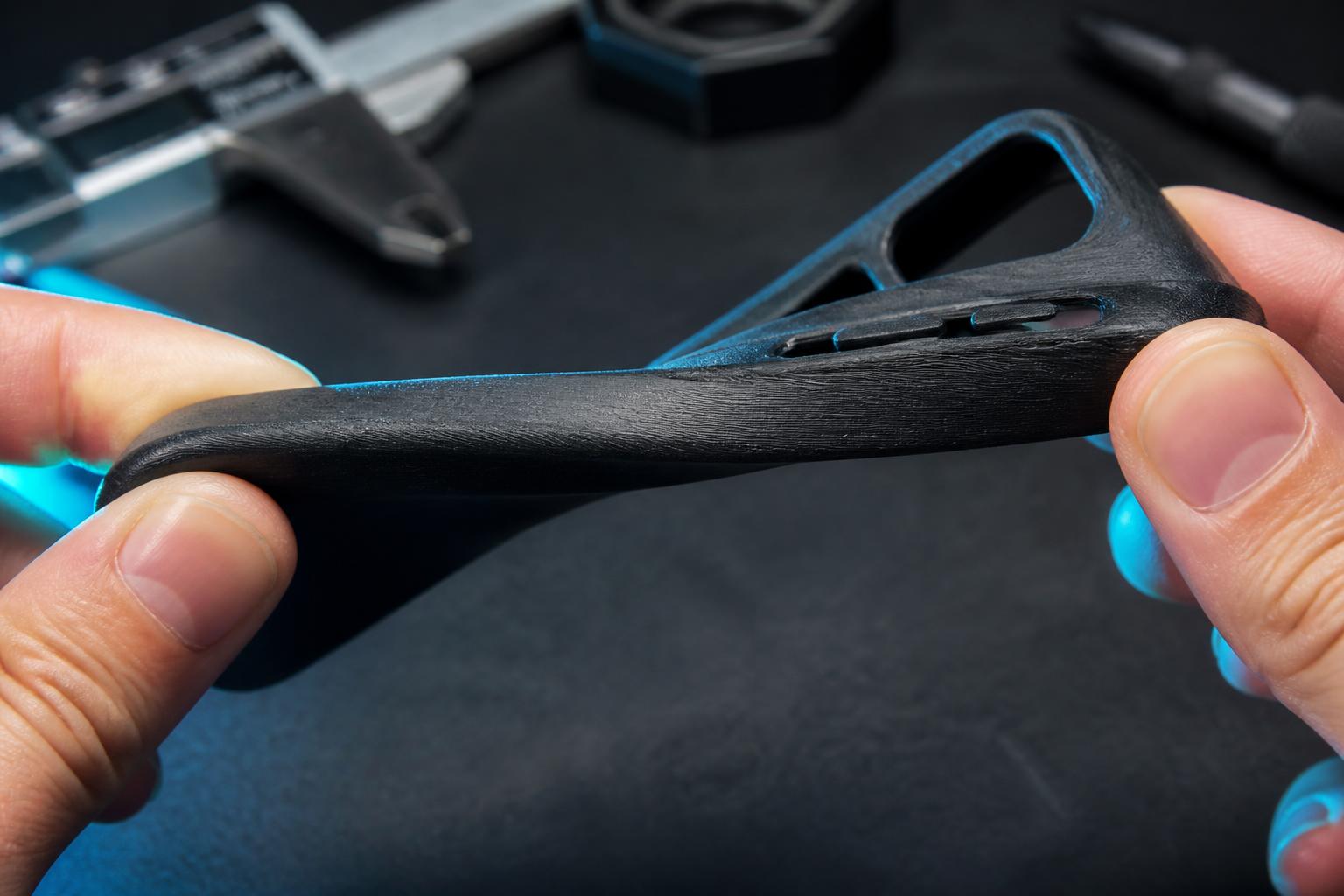
TPU (thermoplastic polyurethane) is a flexible filament. In practice, it behaves more like rubber than plastic. It bends, stretches and absorbs impact instead of cracking.
TPU comes in different hardness levels. A common grade for 3D printing is called 95A. That is roughly as firm as a phone case or the sole of a running shoe. Softer grades exist, but they are much harder to print well.
Where TPU works best
- Phone cases and protective bumpers
- Gaskets, seals and anti-slip feet
- Wearable parts such as watch straps
- Anything that must flex again and again without breaking
Where TPU struggles
TPU prints slowly, so flexible parts usually take longer to make. It also cannot hold a rigid shape. Therefore, it is the wrong choice for anything that needs to stay stiff, such as a bracket or a stand.
PLA vs PETG vs TPU: side-by-side comparison
The table below compares each 3D printing material at a glance. Use it as a starting point, not a strict rule.
| Property | PLA | PETG | TPU |
|---|---|---|---|
| Detail and finish | Excellent | Good | Fair |
| Strength and toughness | Rigid but brittle | Strong and tough | Very tough, flexible |
| Heat resistance | Low (about 55–60°C) | Medium (about 80°C) | Medium |
| Flexibility | None | Slight | High |
| Outdoor and UV use | Poor | Good | Fair to good |
| Best for | Decor, models, lithophanes | Functional and outdoor parts | Cases, seals, wearables |
How do you choose the right 3D printing material?
The best 3D printing material depends on how the finished part will be used. Ask yourself four simple questions before you order.
1. Where will the part live?
Indoors, PLA is usually fine. Outdoors or in a car, however, choose PETG. Heat and sunlight are the two biggest reasons prints fail.
2. Will it take knocks or load?
If a part will be dropped, clipped, screwed or loaded, PETG is the safer option. PLA is stiff, but it can crack under sudden force.
3. Does it need to bend?
If the part must flex, grip or cushion, TPU is the only one of the three that truly does the job.
4. How important is fine detail?
For showpieces, small text and photo-based prints, PLA gives the sharpest result. That is also why we print lithophanes in PLA.
Which 3D printing material is best for common projects?
Here are some quick recommendations for popular jobs:
- Figurines and display models: PLA, for crisp detail and colour choice.
- Car phone holders and dashboard parts: PETG, because of the heat inside vehicles.
- Garden and outdoor fittings: PETG, for its weather and sun resistance.
- Phone cases and bumpers: TPU, to absorb drops.
- Photo gifts and lithophanes: white PLA, for the cleanest light transmission. Learn more in our guide to what a lithophane is.
- Housings for NFC tags: PLA or PETG, depending on where the tag will be used. See how NFC tags work.
Common mistakes when choosing a 3D printing material
Many print failures come down to a few avoidable choices. For example:
- Using PLA in a hot car. It may warp within a single summer afternoon.
- Choosing TPU for a stiff part. It will bend when you need it to hold its shape.
- Picking glossy PETG for tiny detail. Matte PLA usually shows fine features more clearly.
- Ignoring wall thickness. Even the right material fails if the walls are too thin.
Does print design matter as much as the 3D printing material?
Yes, it often matters just as much. Even the best 3D printing material will fail if the part is poorly designed or printed. Three factors make the biggest difference.
Wall thickness
Thicker walls make a part stronger and more rigid. For example, a bracket with thin walls may snap, while the same bracket with thicker walls holds firm. Therefore, we check wall thickness before every functional print.
Infill
Most 3D prints are not solid inside. Instead, they use an internal pattern called infill. Decorative pieces may only need a light infill. Load-bearing parts, on the other hand, need more. More infill adds strength, but it also adds weight, time and cost.
Print orientation
3D prints are strongest along their layers and weakest between them. So the direction a part is printed in affects where it might break. For instance, a hook printed on its side is usually much stronger than one printed standing up. This is one reason we like to know how a part will be used.
How does heat affect each 3D printing material in South Africa?
Heat is the most common reason prints fail here. On a hot day, the inside of a parked car can reach well above 60°C. Dashboards in direct sun get even hotter. As a result, PLA parts left in a car can sag or twist.
PETG copes much better, because it softens at a higher temperature. TPU also handles warm conditions reasonably well, although it stays flexible. So if a part will spend time in a vehicle, on a window sill or outdoors, we strongly recommend PETG.
Indoors, however, PLA is usually perfectly fine. Normal room temperatures are far below its softening point.
How long do 3D printed parts last?
With the right 3D printing material, printed parts can last for many years. The key is matching the material to the conditions.
- PLA indoors: can last for years when kept away from heat and strong sunlight.
- PETG outdoors: holds up well to sun and rain, although colours may fade slowly over time.
- TPU in regular use: stays flexible and resists wear, which suits cases and grips.
In short, most early failures come from using the wrong material, not from 3D printing itself.
Can one project use more than one 3D printing material?
Yes. In fact, many good designs combine materials. For example, a rigid PETG case can use separate TPU feet for grip. Similarly, a PLA display stand can hold a flexible TPU insert. We can print each part in the material that suits it best.
Frequently asked questions
Is PETG stronger than PLA?
Yes, for most everyday uses. PETG is tougher and more impact-resistant than PLA. PLA is stiffer, so it can feel solid, but it tends to crack under sudden force. PETG bends slightly first, which helps it survive drops.
Can PLA be used outdoors?
Only for short periods or in shade. Sunlight and heat soften PLA and can make it brittle over time. For anything that stays outside, PETG is the better 3D printing material.
Is TPU waterproof?
TPU itself does not absorb much water, and it works well for seals and gaskets. However, a printed part is only as watertight as its design and wall thickness. For a sealed part, let us know so we can plan the print settings.
Are 3D printed parts food safe?
Be careful here. Some filaments are sold as food-safe, but printed layer lines can trap bacteria. For this reason, we do not recommend 3D printed parts for repeated contact with food or drink.
Which 3D printing material is cheapest?
PLA is usually the most affordable, because it is the easiest to print. PETG and TPU often cost a little more. TPU in particular prints slowly, which adds machine time.
Still not sure which 3D printing material to pick?
Here is the quick rule of thumb again:
- Choose PLA for detailed indoor pieces.
- Choose PETG for strength, outdoor use and functional parts.
- Choose TPU for anything that needs to flex.
If your project does not fit neatly into one box, that is completely normal. Simply send us your file and tell us how the part will be used. Then we can recommend the best 3D printing material for what you are building. You can also contact us with any questions before you order.